
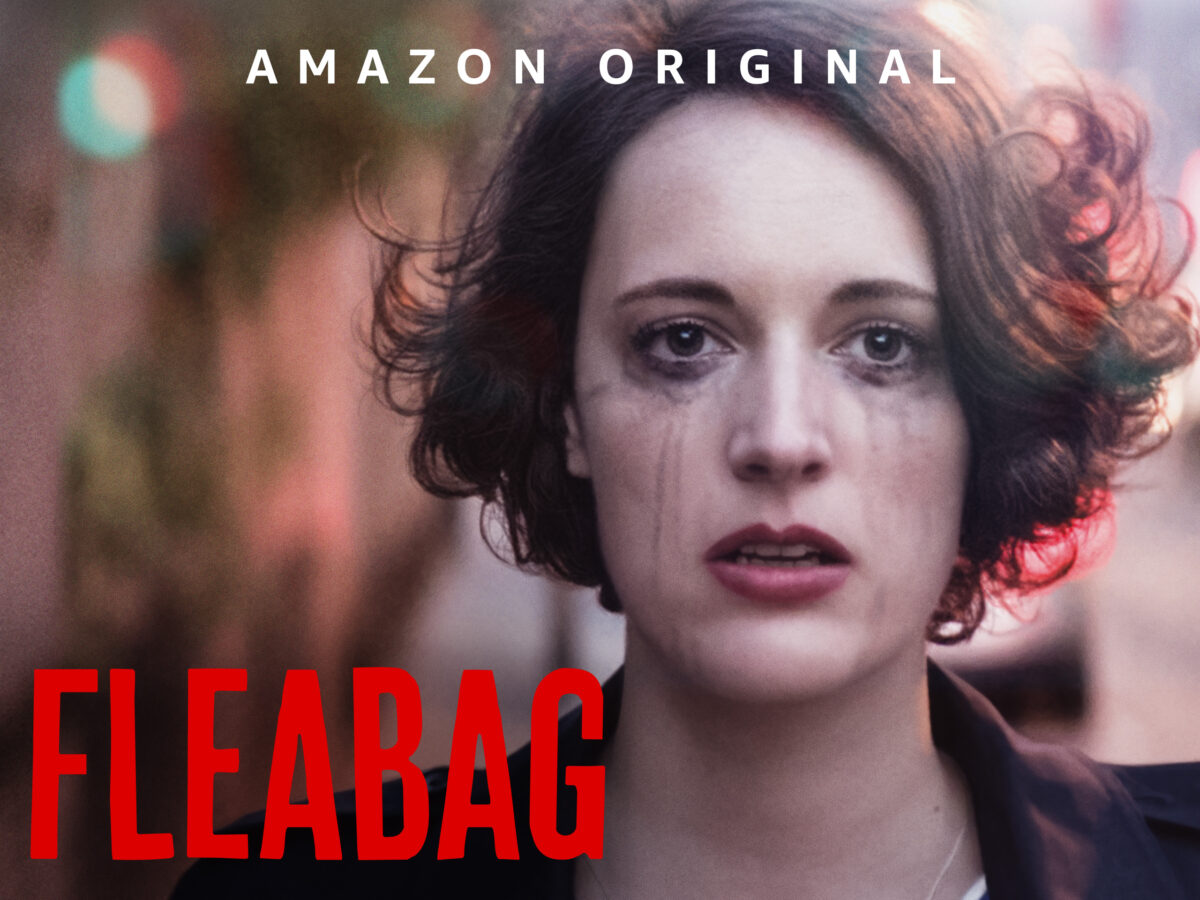
“Fleabag” is the only romcom I’ve seen about the protagonist’s sister. Make no mistake, the show bills itself as a love story, and the unnamed protagonist (Phoebe Waller-Bridge) does fall in love with a Priest (of all people), but her sister, Claire (Sian Clifford), has to learn that love is worth chasing after. Being that “Fleabag” is soon to turn ten years old and that 2016-focused nostalgia is becoming a bit of a trend right now, the series is worth examining as a time capsule of mid-2010s feminism and optimism. Adapted from a 2012 stage play of the same name, Phoebe Waller-Bridge’s television debut takes many forms. Tragedy, comedy, romance, slice-of-life, sure, but at its core is the story of a struggling café owner’s inability to grieve and connect with others following the deaths of her best friend, Boo, and her mother. The depiction of Fleabag’s (the character’s) mourning is painful and realistic. Her desperation to be seen, let alone loved, becomes strikingly apparent in one of the best television monologues of the century located at the end of season one’s finale. Above this aspect of the show, however, lies her relationship with Claire.
At the time of its release, the show’s focus on a woman who drinks, curses, loves, cries and f***s (in almost every episode, occasionally in that order) gave “Fleabag”a substantially progressive reputation. A lot has been said about the show’s use of fourth-wall breaking to deliver these inner thoughts, and while by now it feels like more of a clichéd exposition device, the asides give the protagonist some much-needed agency. Even though the show never had the most diverse casting calls, “Fleabag”s confrontational approach to gender roles are undoubtedly forward-thinking. One of the protagonist’s defining features, explored across both seasons, is her perceived inability to live up to forms of “ideal womanhood” espoused by younger and older generations. In season two, she is guided to speak to a Quaker congregation during a meeting, where she says “sometimes I worry I wouldn’t be such a feminist if I had bigger t**s.” Fleabag’s relationship with womanhood and feminism is a key thematic element of the show and its legacy, one best analyzed from the perspective of the closest woman to the protagonist, her sister. For the uninitiated, spoilers lie ahead from here, but I seriously recommend watching the show, it’s a tremendous use of five hours.
Claire lost her mother too. It’s easy to forget this, as her coping strategy involves masking her grief through her corporate success, both idolized and disdained by Fleabag. In the season two premiere, Claire announces to her family that “in the last six months I have excelled, I just take all my negative emotions and bottle them up… I’ve basically never been better!” Her repression serves as a sharp foil to Fleabag’s need for catharsis in the face of their shared trauma. As Fleabag validates her insecurities by comparing herself to other women, much of Fleabag’s insecurity comes from comparison with Claire. Fleabag introduces her sister in season one by calling Claire her “super-high-powered-perfect-anorexic-rich-super-sister,” showing that her sister’s status and appearance are objects of jealousy. To Fleabag, Claire originally embodies a version of ideal, unattainable femininity that slowly unravels with the growth of their relationship.
Later, Claire hires her sister to cater a prestigious award ceremony for women in business. This episode, season two episode three, reveals much about the inner workings (and dysfunctions) behind Fleabag and Claire’s relationship. Several things go wrong at the ceremony, from vegetarian businesspeople falling ill from misplaced meat, to Fleabag accidentally shattering the award itself and having to steal back the replacement from the winner. After the ceremony, in a heated exchange, Claire states that she is not friends with her sister, and that the label of “friend” is antithetical to their relationship as it was. In a monologue, Claire says that she’s deeply jealous of Fleabag, her resilience, her sexual freedom, her ability to maintain her identity after surviving tremendous losses. This subverts the entirety of what we’ve known about their relationship so far, recalling Fleabag’s longstanding jealousy over his sister’s status-based success.
Claire’s admission of jealousy comes as a stark surprise. Fleabag started the show wearing Claire’s stolen clothes and begging for her sister’s money, and now stands over her sister, hiding her face behind her work computer. Claire’s monologue takes place in her office, which seems to be the size of (if not larger than) the entirety of Fleabag’s café. The room represents Claire as a powerful, wealthy, respected corporate executive. The walls are adorned with trophies and books, the lack of photos or distinguishing art recalling Claire’s withdrawal from family and friendship. A series of close shots keeps the focus on the womens’ faces while obscuring all windows, doors, and other exits to the room, showing that they’ve become trapped in their roles in each others’ lives. In other words, Claire’s office is her cage. The office’s low, warm light highlights Claire’s awards, contrasting the cold blue-ish computer illuminating the side of Clifford’s face as she makes her admission. Like Fleabag, Claire lives in the shadow of her success.
The sisters don’t make up and hug it out after this. It’s not easy to forgive, as the show has made clear from its beginning. Rather, Fleabag realizes that both women had been raised to feel inferior to the other. Fleabag learns that Claire’s status, family, and money hasn’t shielded her from the insecurities and pain that they were born to carry. Fleabag’s awkward interactions with Claire get more manageable after the office monologue, but there’s no catharsis of tears and acceptance. They simply learn to live with each other, which is more poignantly realistic. While “Fleabag” season two presents itself as a love story between the titular character and the Priest, the rediscovery of her sister’s love is crucial to her healing. While the Priest’s steamy affair got much of the attention, not enough discussion focuses around the show’s protagonist and the woman whose support she had to learn she could count on. Yes, she left the audience behind, but she’s no longer as alone as she once feared. Even if it’s not a hot Priest, there’s still someone who’s willing to listen to her, even after some incredibly questionable decisions.