
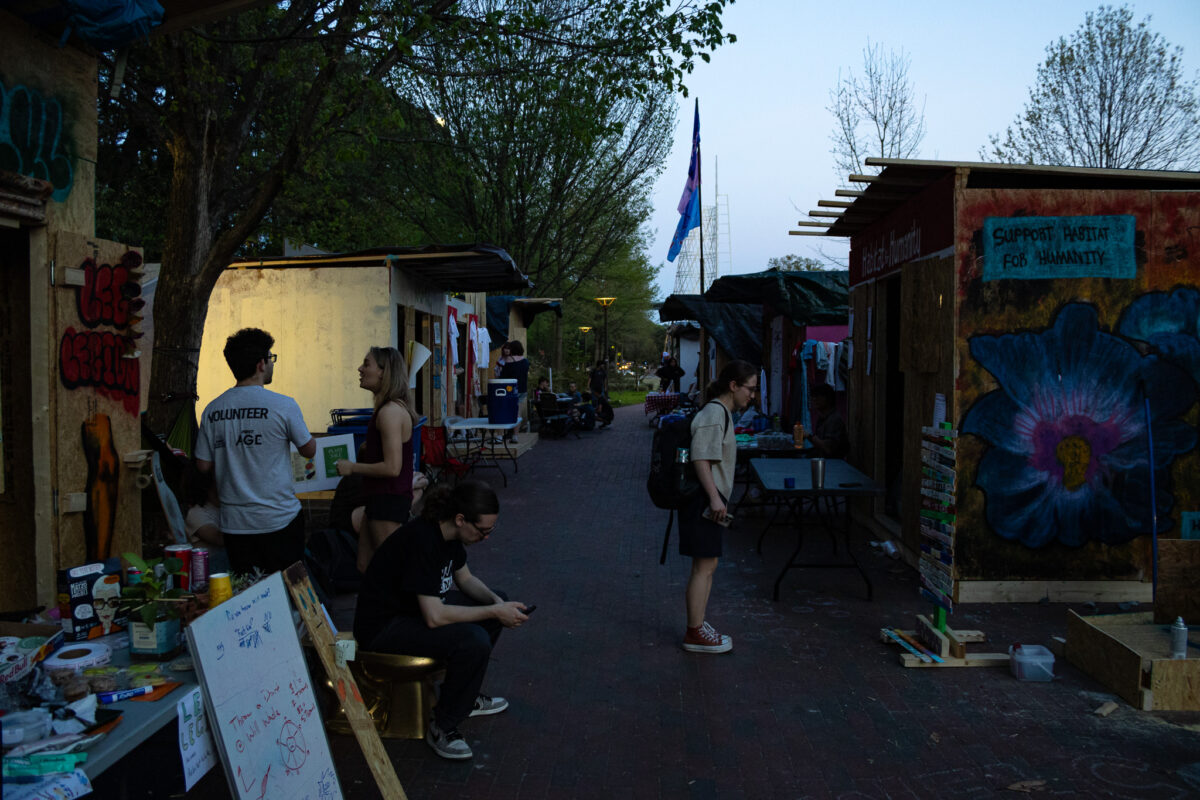
Photos by Lachlan Vester.
As I wake up on a brisk March Sunday morning, I realize what day it is. It’s Shack-a-Thon week, I think to myself as I roll out of bed. After what I imagine to be an getting ready montage of epic proportions, I go to start my car, a 2018 Chevy Cruze, the hatchback only to realize there is frost on my windshield. After scraping whatever frost late march can muster off of my car and hopping in I start my playlist to the tune of Geese and start out to the station. Yet another uneventful drive to campus I think to myself as I let the music consume me for the short eleven minute drive. Of course in my excitement to start the day, a rarity in the monotony of the end of a semester, I did not seem to realize that there was something I was forgetting. 9:30, That’s what I was forgetting. You see, as I walked into the studio at around 7:30 it hit me. Nobody will be here for a solid two hours.
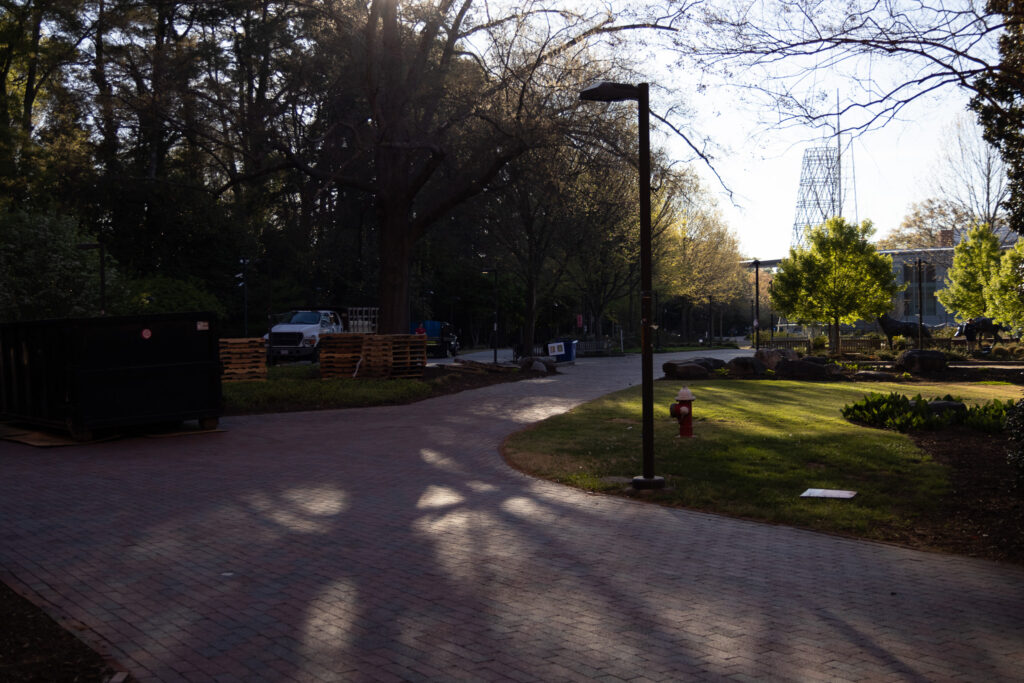
Here might be a good place to explain what Shack-a-Thon is to my non NC State audience. Shack-a-Thon is a fundraiser where NC State student organizations build “shacks” and live in them for a week to raise money for Habitat For Humanity. These shacks are usually planned out by the orgs and built by students to withstand the week. While there are some regulations in place, the design and building is left up to the students. In my infinite drive to investigate the anthropological ideas behind everyday life, I have decided to document the process, the living, and the fun of Shack-a-Thon for the purpose of understanding the informal settlements and maybe, just maybe urban life and community.
The idea of a one week city caught my attention almost instantly. The novelty of the ability to study such a short-term encampment, while being a part of it was intriguing to say the least. I saw it all happen last year, however, I didn’t think of it as an object of study. This semester changed everything for me, I started a course in urban anthropology and the idea was like sparks flying in my mind. By early March, I couldn’t stop thinking about it. The whole thing was intoxicating to me.
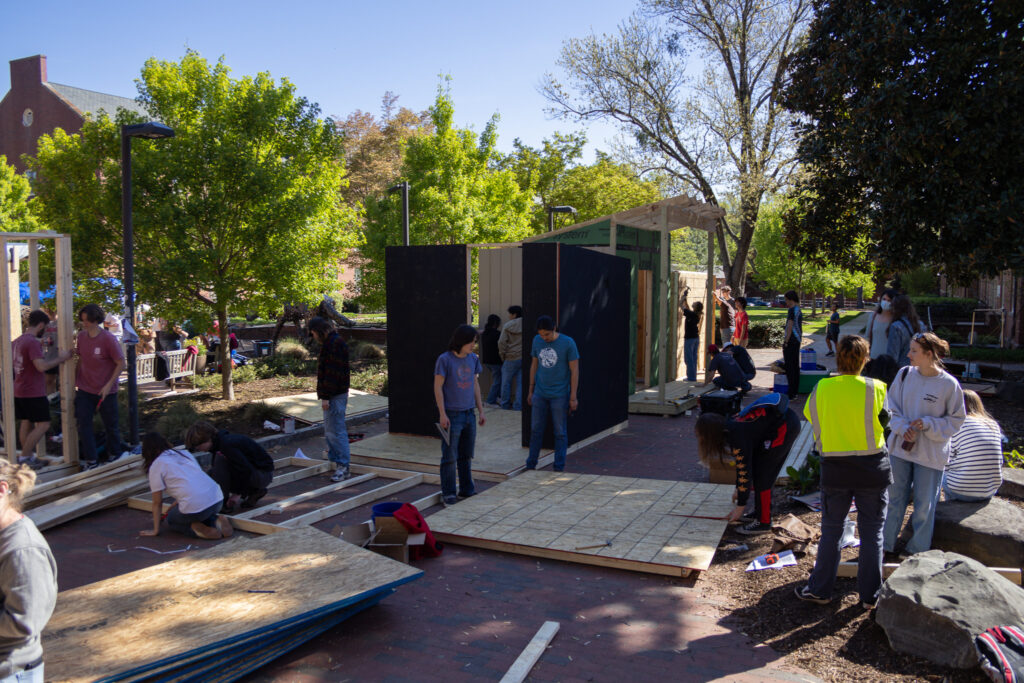
Throughout the day the WKNC shack came together, with a few hick-ups. As I’m writing this I am still in the shack, tired, but proud of what our team had created. With just some hammers, and a lot of nails, we built a full structure, a shack if you will. This shack is what I hope will be the beginning of a beautiful community gathering. The small city that we have erected in a day was around twenty shacks strong. Even within the building of this informal settlement, there were glimpses of what will be in the little gestures of kindness between groups all working towards the same goals. A shared hammer, an extra set of hands when they were needed, the kinds of things I was hoping to see coming into this project. I am what I would call optimistic at this moment. It’s the kind of optimism that I don’t feel often, the kind that takes a lot of hard work to gain. Hard work that I one hundred percent put in today in raising the shack from the ground up.
After a much needed walk around the area I have decided to name the area Shackville and will be referring to the collective area as such for the rest of my time writing about it.
Entering day one of the official Shack-a-Thon the community was starting to grow. I arrived in the morning sore and groggy from the fifteen hour day that I put in the previous day. As the day moved on, I began the work of parsing out information through both observation and actually talking to people.
Starting with the observational data I was able to recover from this first day, there were a couple of things I noticed. For starters, the WKNC Shack does not have much to offer in terms of the urban environment feel I was looking for. This is because it is on the outskirts of Shackville. As you move further in, to the more expensive and high-traffic areas, I began to notice a trend of community and competition. Through the fundraising efforts of the shacks, rivalries began to form between neighbors. While some shacks were friendly with one another, others were in stark opposition to one another. This trend was especially noticeable between the Greek life shacks near the center of Shackville. Now at this current moment I am conflicted in my assessment of this correlation. On one hand it could be that the shacks are in a far denser area of Shackville, on the other could the organizations have prior interactions I am unaware of? This question will require further investigation throughout the week.
here are two main strips of Shackville, The front row being more of an outer rim and the inner main concourse. The inner concourse represents an urban center to the settlement of Shackville. This urban center creates a tighter-knit community, while also breeding competition between shacks. There is more of a suburban environment in the outer ring of Shackville. This suburban vibe is extremely important to understanding the idea of what makes the area an urban environment.
After speaking with several residents of Shackville on the topic of competition I have concluded that while the competition was prevalent during the day in good fun of course, there was always the knowledge that once the sun was down, everyone would come together and be friends once again. This was part of the magic of Shackville, no matter the day, something was always happening to make it special. Like I have said before, there was always companionship when needed, despite the competition.
Through speaking with members of different shacks, I have been able to gauge that the more central the shack, the more competitive the different groups are with one another. The dense population of the central area of Shackville adds to the competition as each shack is vying for the attention of shoppers on the strip.
As the night rolls around and the environment becomes a lot less connected. Participants trend towards the insides of their shacks and begin to socialize within their established cliques. This creates a more quiet, calm energy that permeates the entire grounds of Shackville. This calm is where the beauty of Shackville shows the most. As groups of residents gather in their shacks for the night playing board games and instruments or just conversing between themselves, the community begins to shine through. After dark, the quiet permeates the air as the street lights flick on. This time is where the multiplicity of Shackville stands out. As the people of Shackville return to their cliques and mesh less with one another, they begin to display how diverse the area really is. The individual cultures of each shack are of full display throughout the night. From the WKNC shack playing music in a mini jam session, to the games of stump being played by Ski Club, each shack has its own culture of full display during the night.
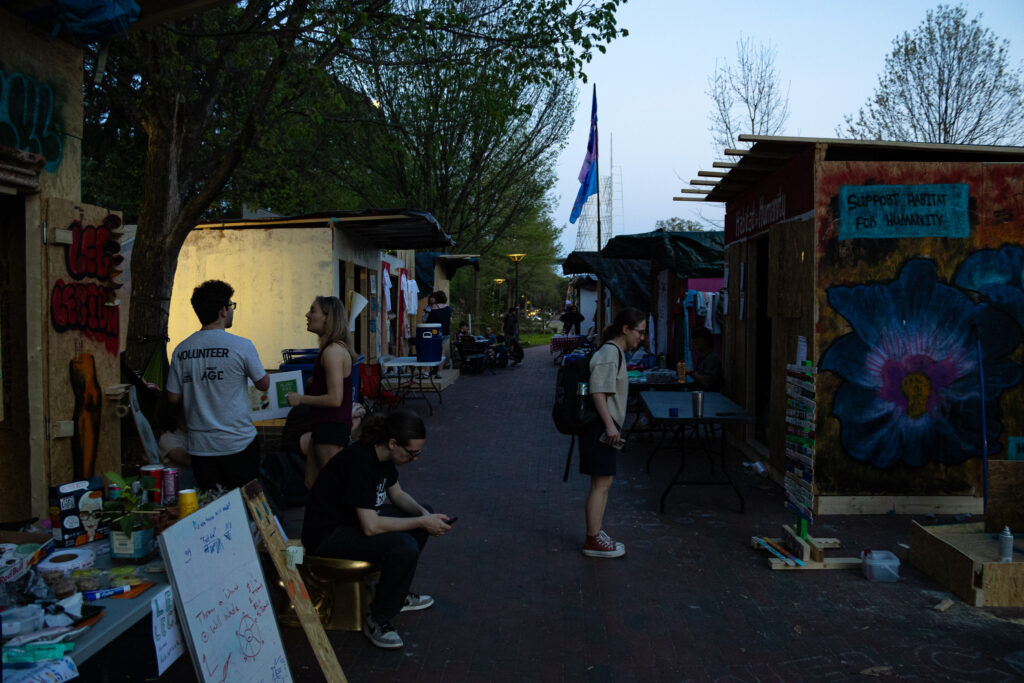
Day two of Shackville involved a lot less sales as the cliques began to deepen their ties within themselves. As neighbors begin to become more comfortable with each other, these cliques begin to include members of other shacks as bonds form through inter-shack sales as they begin to spike. An example I personally experienced was the sales between WKNC and Backpacking club. A trade of goods between shacks began to form through borrowing items and trading sale items. I was able to borrow a drum from Backpacking club in exchange for a wheel spin at the WKNC shack. These trades exemplify the informal economy forming between residents of Shackville.
While the different cultures of Shackville are a huge standout piece of the puzzle, the melding of these cultures into a Shackville culture was evident by about night three. The nightly culture of Shackville was like a microcosm of college life where everyone is having a good time, despite homework and finals coming up. The life at Shackville is a life of no worries and no sense of the week ending.
While in the early stages of this project I was under the impression that there would be a lot less of this inter-shack community and trade, however, as the week moved forward there was a clear change in how different shacks interacted with each other. The multiplicity of Shackville gave way to a hegemony of culture. From different sales tactics being coopted to the actual items being sold having been copied by different shacks. The biggest example of this that I noticed was the “pie a shack member” pitch. This idea started around the beginning of day two, to be honest I am not sure which shack offered this first.
By day four, there had been a full co-opting of the “pie a shack member” idea. The spread to other shacks had been almost instant. There were at least three shacks with this on their menu of things you could donate for by Thursday. Another popular item was a wheel spin for a random prize. These wheel spins were popular from day one as they were an easy and colorful way to draw people into your shack. There were three to four shacks that included a wheel. These include the casino shack, WKNC, and Alpha Phi Omega. This method of drawing people in was extremely popular within the Shack-a-Thon event. In the context of the WKNC shack, this was the most commonly sold option at the table despite the pricing being the same for the wheel as the things on the wheel.
A uniting factor of Shackville, especially after hours, was music. Due to a ban on amplified sound, the music scene was fully acoustic. This means nearly every shack had guitars, banjos, and cajuns galore. Jams between shacks were common, jams within shacks even more so. At the WKNC shack jams were a nightly occurrence with everyone singing along throughout the night.
Shackville’s atmosphere after hours on the final night is one of a mass hangout that will never end, despite the impending doom of the shacks coming as soon as the next morning. Dancing, singing, playing the guitar, and general socialization is at its peak tonight. The population has jumped from previous nights as everyone says goodbye to their own piece of shack heaven. The shacks have brought us together, created rivalries, friendships, and bonds of every kind.
The party didn’t stop until around three in the morning on the final night of Shackville’s existence. There was a congregation of people from all of the shacks sharing the night. This was something really special to me as an anthropologist. Being able to see a community, my community comes together in such a way. Being a part of this adventure was like nothing I have ever experienced before. The people I met, forgot their names, and met again, made Shackville a special place to me.
With that sappy section out of the way, lets have another one:
I want to take this last paragraph to thank everyone who made Shackville what it was. From Habitat NCSU to WKNC, to all of the different organizations on campus that came together for this event. I also want to shout out a few people in particular including: Ayla Bosnian, a fellow anthropology student at state, Dr. Christian Doll, my urban anthropology professor and most of all: Sarah Hernando, WKNC’s General Manager for putting together the best shack of the event in my heart.
-Lachlan Vester