
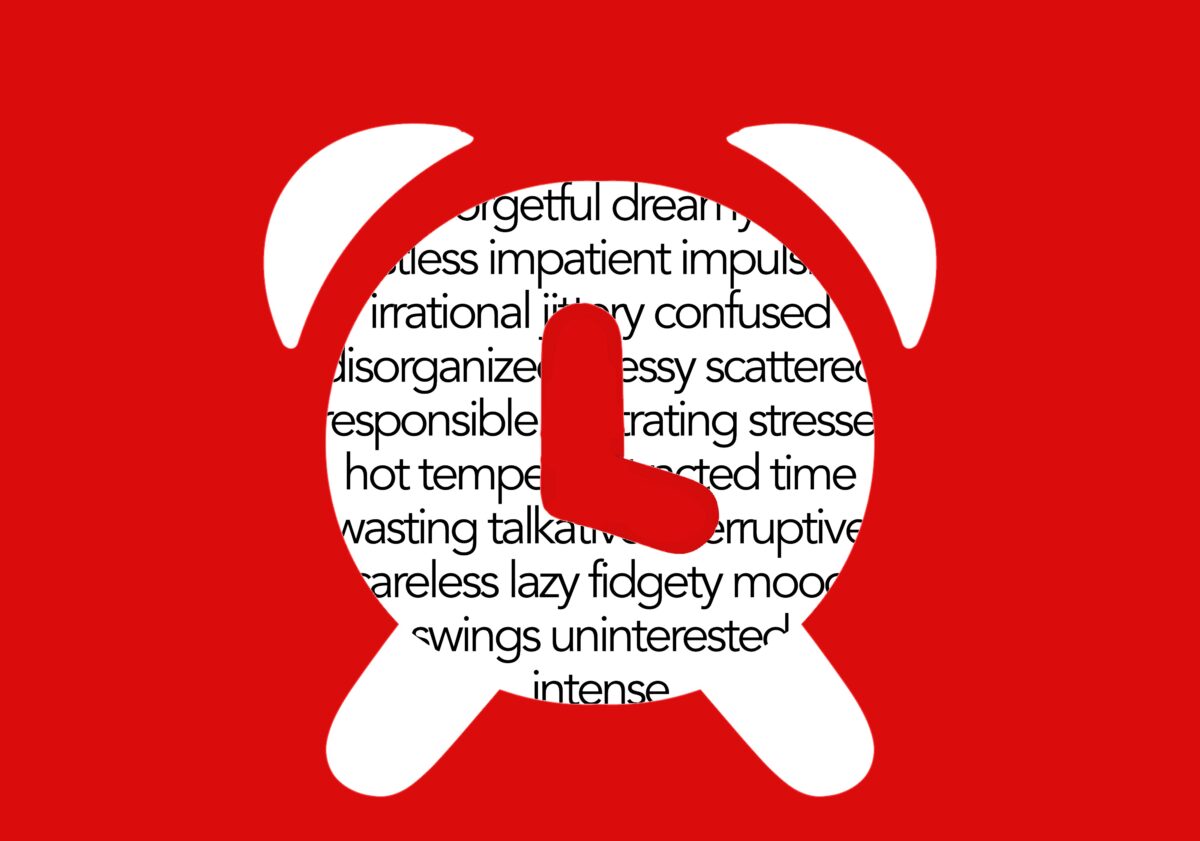
Have you ever wondered why you let spaghetti expire in your fridge for three months, skipped an entire week of classes, and forgot to wish your best friend of ten years ‘Happy Birthday’?
Consider the possibility that there is a dopamine pothole in your brain, and it ate your spaghetti, classes, and best friend.
That dopamine pothole, aka ADHD, is characterized as a deficiency of dopamine and norepinephrine in your frontal lobe which detrimentally affects impulsivity, attention, and memory.
Coming from a diagnosed neurodivergent and professional procrastinator, I intimately understand how symptoms of ADHD can quickly spell catastrophe for college students.
For this reason, I’ve written a ADHD college survival guide. Below, you will find tips and tricks interspliced with unhinged wisdom on how to balance your academics, social life, and dopamine pothole without going insane.
Introduction: A Brief History of the “The Minimal Brain Dysfunction”
Throughout the 20th century, many epithets have attempted to capture the dreaded dopamine pothole.
In 1968, child psychiatrists referred to the insidious pothole as hyperkinetic impulse disorder. Twelve years later, the American Psychiatry Association renamed the confounding pothole to Attention Deficit Disorder in 1980. In 1987, just seven years later, the APA renamed the pothole again – however, this change would shift the course of pothole research. Forever.
Instead of Attention Deficit Disorder, the dopamine pothole would now be called … Attention Deficit Hyperactive Disorder. Save your applause, please.
Snideness aside, there’s a good reason why the acronym ‘ADHD’ has persisted for the past half-century with little change. The diagnosis presides over an expanded and nuanced set of criteria that covers all affected parties, whether it be the restless kindergartener, daydreaming artist, or lethargic office worker.
As university students, we find ourselves in the middle of that pack.
Driven by the restless passion of our teenage years and weighed down by the lethargic responsibilities of adulthood, the college experience can best be described as the highest of highs and the lowest of lows.
Realizing that you have ADHD will be one of those lows for many students.
Dorm/Apartment Necessities
So, it’s your freshman year at NC State and you’ve just moved into your first ever college dorm.
You’ll sleep, study, and cry in this room for the next eight months—it’s imperative that you make this a space appropriate for human inhabitation, especially if you have a brain easily affected by workplace hygiene. Everything from decluttering to decoration will be unimaginably important to maintaining your work ethic and mental health.
Starting off with the most basic but necessary essentials list, here are four dorm/apartment necessities I found the most useful.
- Ambient Lighting (desk lamps, floor lamps, string lights): Dorm rooms tend to come with cool-toned fluorescent overhead lights, similar to the lights present in typical American school classrooms. My roommate and I used to call our overhead light ‘fluorescent death.’ While cool toned-lighting does promote focus, you’ll need comforting and relaxing lighting to wind down after a long week of classes—classes that will all likely have cool-toned lighting already. ADHD is often comorbid with anxiety disorders and freshman year will be stressful enough trying to find your footing amongst your new classes and friends. Therefore, it’s important that you create a calming room to come back home to.
- Storage Bins, Desk Bins, and Desk Shelves: There will be criminally little horizontal space on your dorm desk. Major Willian Le Baron Jenny, architect and engineer, ran into the same problem in 1885–he went on to build the first skyscraper in America, being one of the first modern geniuses to realize the idea that vertical space is practically unlimited. Your dorm ceiling will not be sky high, but it will support significantly more vertical than horizontal space you can capitalize on. Desk shelves that you can vertically stack desk accessories, trinkets, and folders/binders in easy reach will be excellent for staying organized and reducing visual distractions that may make you overwhelmed.
- Noise Cancelling Headphones or/and Ear Plugs: Sound affects both neurodivergent and neurotypical students in different ways. However, if you’re easily irritated by noise like I am, anything from shoe tapping to car honking will bother you. NC State is a loud campus; you will hear near-constant construction near the library, car engines revving every Friday night on Hillsborough Street, and your roommate laughing on call until 3 a.m., among other things. Noise cancelling headphones and ear plugs will save you unbelievable amounts of suffering and frustration when you cannot directly control environmental stressors. You could always move to a quieter area of course, but on an average weekday, most study spots will be crawling with other students looking for the exact same thing.
- Bluetooth Tracker (Apple AirTag, Tile Pro, Moto Tag, Samsung SmartTag2): For those unaware, Bluetooth trackers are key-sized battery-powered devices that can be tracked via syncing to your phone. Bluetooth trackers are commonly attached to keys, wallets, luggage, and pet collars for definitive safekeeping. In our case, whether you live in a dorm or off-campus apartment, you’ll want a Bluetooth tracker for your keys in case you lose them. The average cost to replace a lost dorm key can range from $150 to $350. Losing an apartment key can be even more expensive, running you up to $500 for some complexes. Investing in a $20 Bluetooth Tracker as insurance is a no-brainer—it’ll certainly save you constant unease of and can be reusable for any other essential items. I misplaced my keys six times in my freshman year. By an underserved stroke of luck, I managed to recover them each time except for the sixth and final time. Do not be me in my freshman year.
While there are countless other practical, leisure, and hygiene items that would be important to buy for a dorm or apartment, these four are specifically the items that have helped me the most when it comes to organization and overstimulation.
The Dreaded Academic-Social Balance
There will be times you are excellent in your studies but have zero social life. There will be times when you have a vibrant social life but do horribly in your studies.
Or, there will be times you do horribly in your studies and also have zero social life. I’ve been there.
But the standing question in all of these scenarios is this: how do you balance your academics and social life as a college student?
Do not skip your classes (but if you do, be smart about it)
Before classes begin, make sure to get registered with the Disability Resource Office at NC State and email your professors beforehand to notify them of any accommodations you may need.
Depending on your disabilities, you may be granted early class registration, extra time on tests, extended assignment/project deadlines, and excused absences based on official documentation to name a few possible accommodations.
If and probably when you skip your classes, make sure it is either to study, get class work done, or most importantly, rest. ADHD isn’t simply a disorder of the mind, but of the body too—you may experience insomnia, chronic fatigue, migraines, and sensory overstimulation daily, and you deserve for the afflictions to be acknowledged.
Reach out for direct one-on-one study help
If you’re anything like me, you have an extremely difficult time both paying attention and taking notes during lectures, no matter how engaging the lecturer may be. However, there is a silver lining; office hours with professors are available weekly listed on their respective syllabi where you can ask direct questions and get one-on-one help without distractions.
If one-on-one interactions with professors may be too stressful, student tutors are also available for free hybrid consultations for the courses listed on the Academic Success Center Website.
Regardless of what anyone says, there are no stupid questions. Richard Feynman, the Nobel Prize-winning physicist, once said it himself:
“I would rather have questions that can’t be answered than answers that can’t be questioned.”
Any subject, whether it be physics, mathematics, art, or writing can be questioned or challenged. There is no such thing as common sense — if there were, people would not have believed that arsenic was safe to micro-dose during 19th Century England, would they?
We believe just because we are in the age of information, we have understood most there is to be understood.
However, like how we look down on people who once consumed arsenic, future hindsight will also also prove our current assumptions wrong.
Write notes while completing classwork
I have to confess, I typically do not attend office hours or student tutoring sessions. I much prefer learning on my own in a stress-free environment where I can control the pacing of my learning. I also enjoy application far more than coursework.
In situations such as these, you must learn how to maximize your individual study time as much as possible.
It may be quicker in the short-term to google the answers to open-note classwork, but consider this: the classwork will only get longer and more difficult and you will only get more and more behind. The exam period will roll around, and suddenly you will burn hours upon hours relearning course material from scratch in time for the day of the test. You will lose time to sleep, eat, and spend time with your friends.
If quickly completing classwork without understanding the material is 20% of the time spent on a class, and learning the course material itself is another added 100%, you could easily reduce your study time from 120% to, say, 80% by taking notes while completing classwork.
Go crazy on Friday and Saturday and keep it simple on weekdays
In theory, you could party every single day of the school year and no one would stop you, given that you’re living off campus. Also, given that you have unlimited money to burn.
While I sorely wish I could provide life hacks on how to party every day, the best I can do is give advice on how to party every weekend the right way, guilt free.
That being said, ‘you shouldn’t hit the club on weekdays because you’ll be too tired to go to class tomorrow?’ Weak. Unoriginal.
‘You shouldn’t hit the club on weekdays because they close early, there’s no one there, and you lose sleep for nothing?’ It’s real. It’s terrifying. It’s happened to me. This also applies to casually hanging out with friends too—while there will be those few people who are always down to go anywhere anytime, most people will be busy with classes during the day and then go to sleep at boring times.
Many of your friends will also be free on the weekends; if you slack off all week and save all your work for Saturday and Sunday, the crazy night you’ll have at that club that opens up from 5 p.m. – 4 a.m. and those friends who will definitely be going will sorely miss you.
What I will list next will possibly be the most important piece of advice in this entire article. This tip will not only apply to academics, but anything that is remotely difficult in your entire life going forward from here if you are diagnosed with ADHD.
The Golden 1% Rule
I’ve procrastinated. You’ve procrastinated. We’ve all procrastinated.
Whether it be for days, months, or years, we’ve all put off things that not only we’ve needed but wanted to do.
More often than not, people tell me that their problem is starting; they tell me, if only they bring themselves to start, then they’d be able to bring themselves to finish. That is true in a sense, but doesn’t entail what starting actually looks like.
Let me be the first to tell you, if you aren’t already aware, starting means doing 1%. It means writing one letter on a Google Doc. It means only reading the first question of your classwork. It means turning on your laptop, closing it, then going to sleep.
It does not matter how much you do or how far you go, all that matters is that you go 1%, and tell yourself, I have done enough for this hour, day, or week.
This advice is not implying you only put 1% into your academics. This advice is suggesting that 1% is all you need to tell your brain that you have begun—and not only that you have begun, but you have accomplished something.
Remember, ADHD is characterized by a lack of dopamine that would normally motivate your mind and body to, for lack of a better word, succeed at your goals. If you set the goalpost for starting at completing an entire assignment, the idea of waiting so long for a burst of dopamine is what makes you procrastinate.
By setting tiny, microscopic, goals, you can trick your brain into awarding you a sense of an accomplishment that will naturally motivate you to usually finish more work that you originally intended. However, this advice only works if you truly tell yourself 1% and that’s it.
Sometimes, you will only complete 1% and not feel motivated to finish any more, and that’s okay. You’ve started, and that’s what matters.
The Golden 93% Rule.
If you’ve already guessed, this is the opposite of the 1% rule.
For many students with ADHD, perfectionism is overcompensation for perceived unsatisfactory past behavior and work ethic. Whereas many will struggle with beginning, many will also struggle with finishing.
The French philosopher Voltaire once quoted an Italian proverb which states,
“Perfect is the enemy of good.”
He’s correct—perfecting one’s studying, classwork, or social network is a moot endeavor, because it is impossible to be perfect. ‘Perfect’ is an unreachable standard because human beings are inseparable from their flaws.
We become ill, bored, selfish, tired, and cruel, but there will always be more practice questions to finish, more classwork to be done ahead of time and more people to connect with.
It’s impossible to have a completionist mindset.
And because it is impossible, perfectionists will always be tortured with their own work; never content, never finished, and always painfully aware of their own inadequacies. This is not only bad because it means you take forever to finish, but also because it’ll make you unwilling to begin, too, knowing that it’ll never be perfect enough for yourself.
Strive for contentment and be proud of your own work enough to move on to the next big thing.
Conclusion: Do Not be Cruel to Yourself for having a Brain Disorder
Time and time again, I find my peers in University with ADHD berating themselves for their inferior work ethic. They sheepishly hang their heads and hold their tongues, flippantly assigning blame to themselves in casual conversation, as if they hadn’t just mentally tortured themselves for five hours to finish an insignificantly easy assignment.
This is, in part, due to the societal perception that continues to persist for not only ADHD, but for all mental illnesses. Many believe that because neurodivergency is physically invisible, it is surmountable with enough good, honest, work.
But let me ask you this: is it possible to climb a mountain with a broken leg?
It isn’t impossible—with enough grit, luck, and perseverance, a climber could still make it to the peak. Said climber might even be heftily praised and rewarded for the feat.
That being said, let me pose you another question. Should you have to climb a mountain with a broken leg?
No, of course not. It would be painful, grueling, and above all, needlessly dangerous. But if you had to climb the mountain for whatever reason despite your broken leg, I’d expect that whatever Olympian agency that is sponsoring you would give you a cast at bare minimum.
In this metaphor, the mandatory mountain is life, the broken leg is ADHD, the cast is self-compassion and accommodation, and the climber is the college student. While it may be somewhat empowering to survive university through nothing but rigorous self critique and energy drinks, it is also deeply unnecessary to be so difficult on yourself.
University will possibly be one of the most hectic, joyful, and miserable times of your life thus far. The average number of students in a North Carolinian High school is 2,500. The number of students at NC State is roughly 40,000. The average North Carolinian high school site is 5-45 acres. Just NC State’s main campus is over 2,100 acres.
Transitioning from high school to college for the first time is more than going from the oven to a frying pan, it’s throwing a pond fish into the ocean. Not only will University be overwhelming, it will be unbelievably difficult.
You are not alone. You don’t have to tough university out without any help—help you deserve, because no one asks to be born with ADHD, or any mental illness for that matter.
