
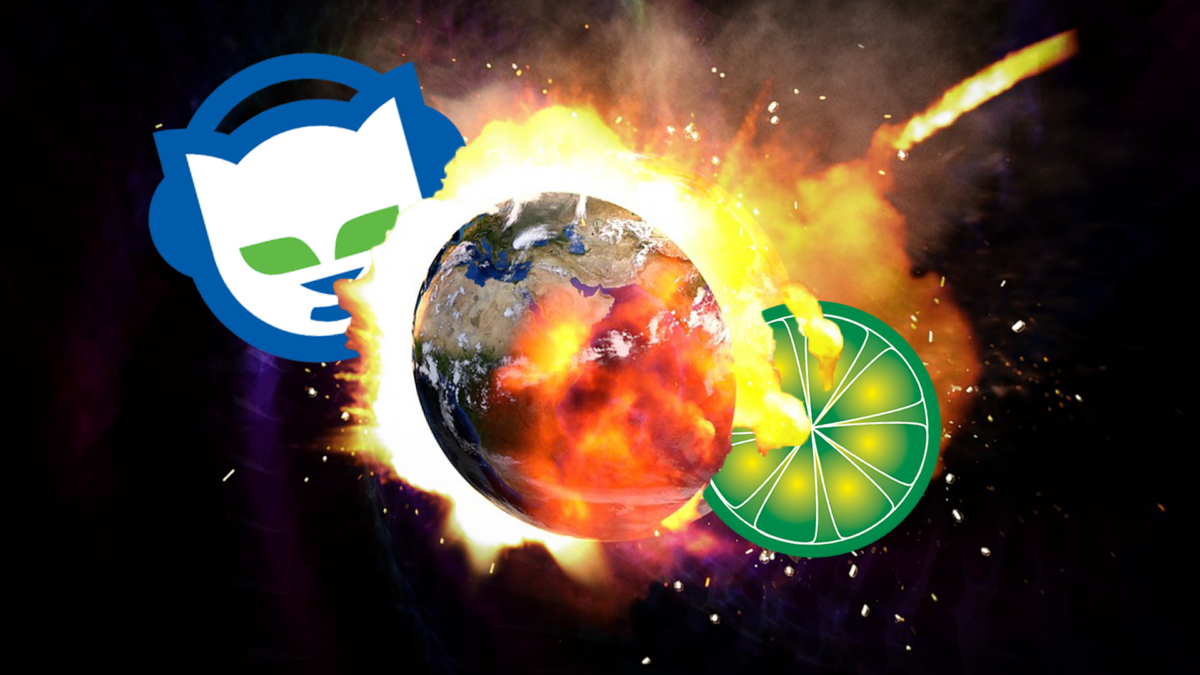
This is a companion piece to a video on WKNC’s YouTube channel, watch it at the following link: “Napster’s Quick Rise and Fall“
Living in the streaming age with so many services is overwhelming. We oft wish for an age where we shouldn’t need to spend tons of money on music services that improperly support artists. Why don’t we just remove that middleman entirely and make it so all artists aren’t paid- at all?
That was the solution Napster, Limewire and dozens other peer-to-peer (P2P) file-sharing sites had in the late 90s and early 2000s. Users could simply upload their own audio files and download, send and recieve files posted by other users. Infamously, both applications had problems with correct labeling of track and artist names. Both Limewire and Napster did more than just music and naturally sometimes had malware packaged in with songs. Naturally, they were shut down fairly fast, but there’s still a fascinating history behind the two.
Believe it or not, but I’m not criticizing either service for giving away music for free. Many who benefited from these services had no feasible way to acquire their own music, whether financially or regionally. It is, however, a fact that they did not pay the majority of artists who had music put on their platforms. This is mainly a problem for smaller artists where every dollar counts to their continued ability to create and release more music.
The systems were very flawed, maybe even outright terrible, but the people using them adored Napster and Limewire especially. They were in widespread mainstream appeal for the majority of their short lifespans (although, technically they both live on through various corporate buyouts). Those who didn’t like the services- really hated them.
Massive artists sued Napster and Limewire until both eventually ended service, in 2001 and in 2011 respectively. Limewire itself faced much bigger and longer-lasting legal troubles that lasted over a decade, with the R.I.A.A. attempting to sue for a ludicrous $72 trillion until it was settled for $105 million in 2011.
Napster has since turned into an A.I. music streaming service, which might also be an A.I. assistant service and an A.I. shopping service too. Maybe even an A.I. art service? The current line its following is horrendously bewildering, with absolutely no focus from the company in charge. To date, Napster has been owned by at least seven different corporations, all of which have had its own goals and ideas without any clear vision.
Limewire’s history is strange after the lawsuits concluded in 2011, as the company behind it does still exist as Lime Wire L.L.C. Since then, it has continued developing file-sharing services though with much less success and have a habit of buying into utterly random brands and projects in the 2020s. Fyre Festival? It’s owned by Lime Wire now after it was put on auction. It’s done licensed Limewire NFTs, purchased a generative AI tool and the former CEO and founder of Limewire is now the co-president of Make America Healthy Again (M.A.H.A.), an organization closely tied to R.F.K. Jr.
What a time to live in. Yet still, we don’t even have any streaming services that let you stream streams. How ghastly.
