
Wikipedia is an interesting place to explore and learn about new things. In my opinion, it is one of the quickest ways to learn about a topic that doesn’t require diving into research or trying to find an accurate source on Google. If I need quick information on a topic, I usually go immediately to Wikipedia.
Sometime last year, I decided to take a dive into Wikipedia’s articles on emo, which led to an interesting discovery of how the editors of these pages view emo. If you’re reading this, join me on a (somewhat) deep dive into Wikipedia’s articles on emo.
Throughout this article, I will include links to various Wikipedia pages. If you want to see for yourself exactly what I am talking about, those are the links that will help you understand more.
An overview of emo
If you have ever listened to WKNC, you definitely at least know of emo. As a genre, emo arose around the mid 80s and early 90s as an expansion of post-hardcore style music, and still exists today as a big music genre with a major impact on modern music, especially indie music. It also has expanded and created some interesting derivatives, some of which have a strong impact on the indie scene of today. It’s also a genre that spawned a subculture (and, following the subculture, a set of stereotypes).
Emo as a genre takes on many different characteristics, many of which align with its stylistic origins in post-hardcore but also expand beyond that. The Wikipedia article chooses to first focus on the unique, sometimes unstructured take that emo dives into, and then focuses on the unique fusing characteristics of emo.
Emo derivatives (and new words you didn’t know)
One of the biggest points of note about emo is the unique new genres and subgenres that it formed. In truth, rarely ever is an emo rock work given just the tag of “emo rock.” Works like “The First Glass Beach Album” by Glass Beach get expanded into fourth-wave (or emo revival), while artists like American Football and Moving Boxes fall into midwest emo.
Diving into the Wikipedia article, I found 4 major linking genres that one could focus on if they wanted more information about emo.
Firstly comes emo pop, which the Wikipedia editors describe as a combination of emo and pop or pop punk. Artists like Fall Out Boy, My Chemical Romance, and Panic! At the Disco are included under this article.
Secondly, midwest emo, described as a genre originating in the Midwestern United States that rooted from math rock and indie rock. Bands like Sunny Day Real Estate and American Football are included in this article. This article also includes our first description of emo waves in a subgenre article, in which it dubs midwest emo as “second-wave.”
Emo revival is the next subgenre that is focused on, being described as an emo genre that takes many of the original emo aspects and combines them with all of the other emo genres, truly making a “revival” as described. Modern Baseball, Title Fight, and Basement are included in the emo revival article. Interestingly, fifth-wave is also included under this article, with bands like Glass Beach and Awakebutstillinbed being included in the article.
Screamo also gets its own description, instead focused on under the subgenre/fusion section of the article. It is described as a blend of emo and hardcore punk with a significant use of screaming as a piece of the sound. Bands like Orchid and I Hate Myself are included in the article.
Wikipedia also has some other articles describing minor emo genres. The Wave and emo rap have their own articles, and are described lightly throughout the primary emo page, which is somewhat odd to me, but I guess they don’t matter as much to the editors. Then, there’s some subgenres which Wikipedia also chooses to describe. Here are each of them (including my response to hearing their names).
- Pop screamo – what?
- Soft grunge – I’m sure this is a real phrase, but when you’re describing it as a blend of “grunge, noise rock and alternative metal” it sounds fake.
- Nu gaze – this one’s a weird one; you would think it would be nu metal and shoegaze, but no! It’s actually more electronic shoegaze, according to Wikipedia.
- Zoomergaze – where did this name come from? Who called it that? Why? I get that it’s shoegaze/hyperpop/nu-gaze/digicore/electronic made by people from Gen Z, but that doesn’t make the name any better.
- Grungegaze – I will continue calling it grunge shoegaze.
Emo comes in waves
What’s so interesting about emo, that the Wikipedia article comments on to great degree, is that emo comes in waves. Yes, other music genres do the same, but emo music often gets described with its waves about as often as its subgenres.
Depending on who you ask, there are four or five waves of emo, with each having its own unique style. The primary Wikipedia article on emo doesn’t describe anything as second or third wave emo, but it does explicitly describe the fourth wave and fifth wave (and fourth-wave has its own article in emo revival).
The Wikipedia articles spoken about throughout this blog chose to align each of the major subgenres with a specific wave. Midwest emo is assigned as the second wave, emo pop is assigned as the third wave, and emo revival being assigned as both the fourth and fifth waves simultaneously.
Wikipedia’s falterings on emo
Wikipedia’s take on emo is definitely interesting. In fact, what originally spurred the idea of this blog (almost a year ago now) was when I spotted the band Imagine Dragons on the emo pop article, which created some frustration in me. Of course, who falls into what genre and why can often be subjective, but there are certain facts that are known.
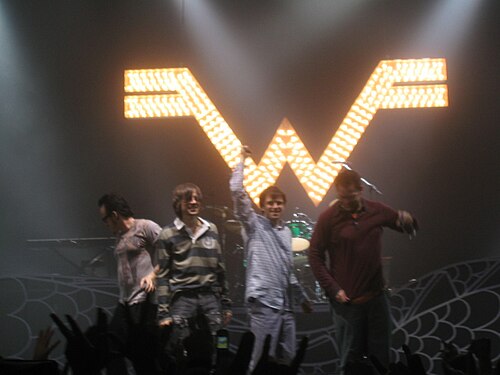
For this very same last reason, the photo utilized as the cover of this article is showing Weezer. While Weezer certainly may have had an impact on emo music, it is questionable at best if they should be included in the sphere as their music falls more in line with pop punk. That said, this Wikipedia article focuses on Pinkerton, under which emo is a correct place to organize it.
So, yes, this article of writing came about because of gripes with the Wikipedia page, but I’m fully serious in pointing out that Wikipedia pages like this have definable issues; but these issues get resolved over time. Imagine Dragons and Weezer have been removed from the emo pop page since my first time reading them, which in turn makes these articles much more accurate than they were previously.
The real good of Wikipedia is that it is community maintained. That means that, even when there are mistakes, someone can see them and correct them. So, thank you to whoever removed Imagine Dragons and Weezer from the emo articles.
