
All photos by Killian Le.
“You have more in common with the neighbor that you hate than a f—ing billionaire!”
The lead singer of Noctomb is grinning at the audience as he snatches the microphone from the stand, shirtless in 30 degree weather.
It’s another Thursday at Chapel of Bones.
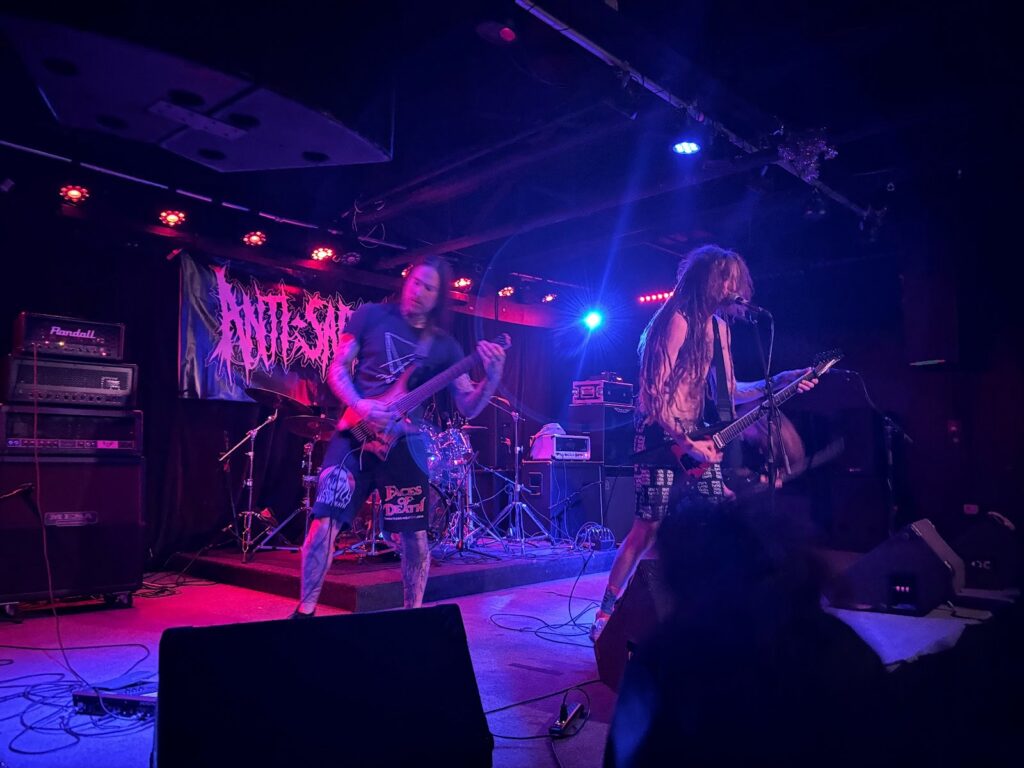
The bands Noctomb, Hitachi Torture, and Dunmharu were the stars of Chapel of Bone’s show “Anti-Sapien” on Jan. 16, 2026. While all of these bands are metal, each had their own unique energy and playing style which kept every consecutive performance of Anti-Sapien electric and heart-thumping.
Especially when it’s a freezing and dreary Thursday night, it’ll take some guitar distortion, screaming, and moshing to warm you up.
Dunmharu:
Dunmharu is a name taken from Middle Gaelic in 1200 AD: ‘to kill,’ is the word’s translation. An apt title, seeing as Dunmharu absolutely murdered the stage.
The drummer, Dave Brantley, and the lead guitarist, James McMillian, sported unbreakable stoic expressions while the lead vocalist, Tanner Collins, stomped about the stage with an cathartic intensity. The bassist, whose name is unfortunately not listed in Dunmharu’s website, tied the performance together with her snappy and resonant baseline.
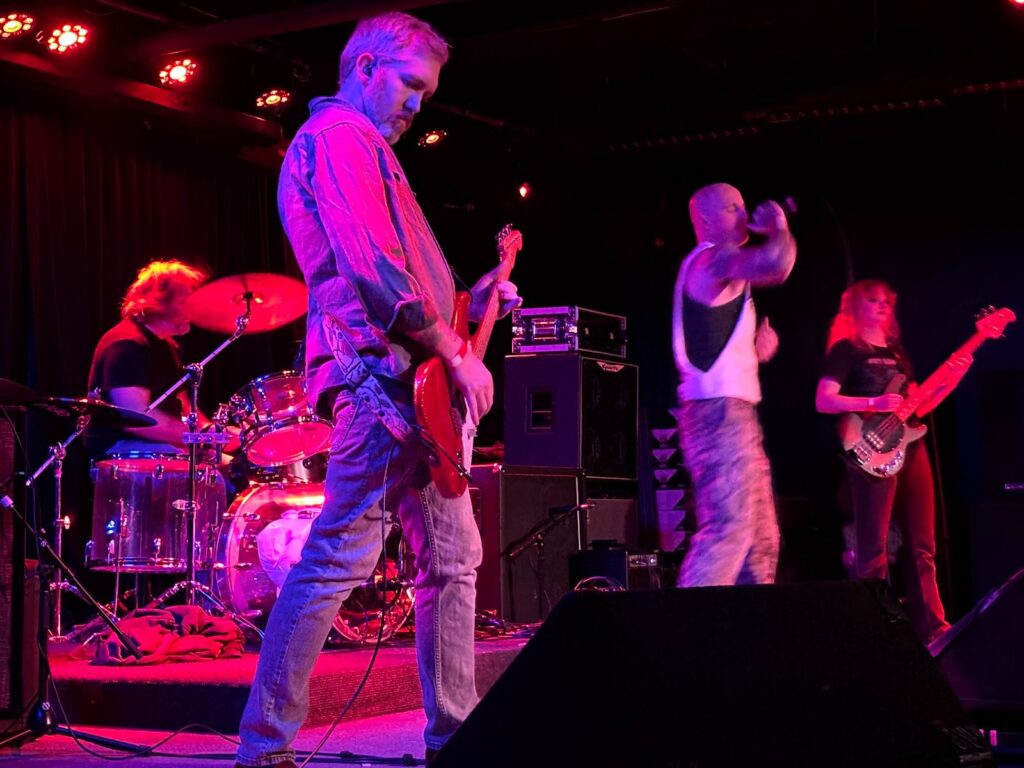
As for Dunmharu’s music? Their songs are classic death metal; heated, angry, and straight to the point. Collins had an exceptional death growl, and filled the venue with his presence more than metaphorically. Midway through their performance, Collins jumped into the crowd, gleefully moshing with a few audience members.
Dunmharu, despite their serious and edgy persona, was the best of the three bands at engaging the audience. Combined with skillful playing and a quality line up of songs, the band made for a great opening performance.
Hitachi Torture:
Now, before I review Hitachi Torture’s act, I have to give some context to the acclaim that surrounds Hitachi Torture’s name. Before the show even began, an audience member informed me that Hitachi Torture was something of a local legend; they were a rising star in Raleigh’s metal community that many had specifically come to watch that night. While not explicitly stated in any promotional material for Anti-Sapien, I reliably assumed that Hitachi Torture would be the show’s unofficial headliner.
But even without that assumption, I would have known that Hitachi Torture was Anti-Sapien’s main act the moment they walked on stage.
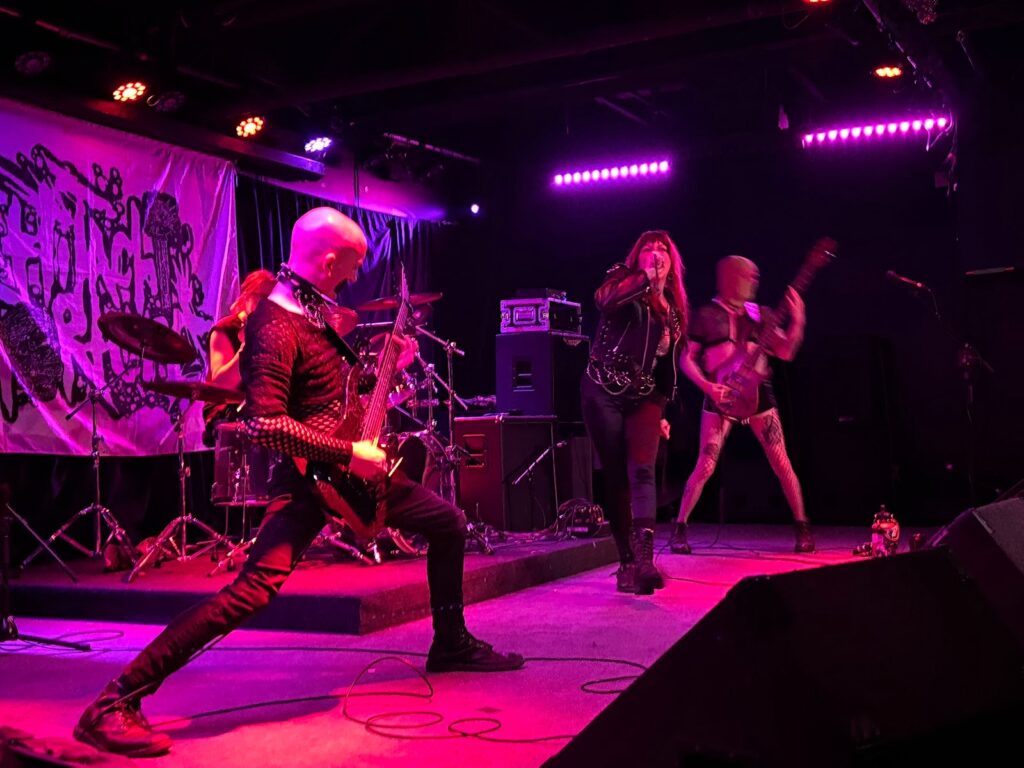
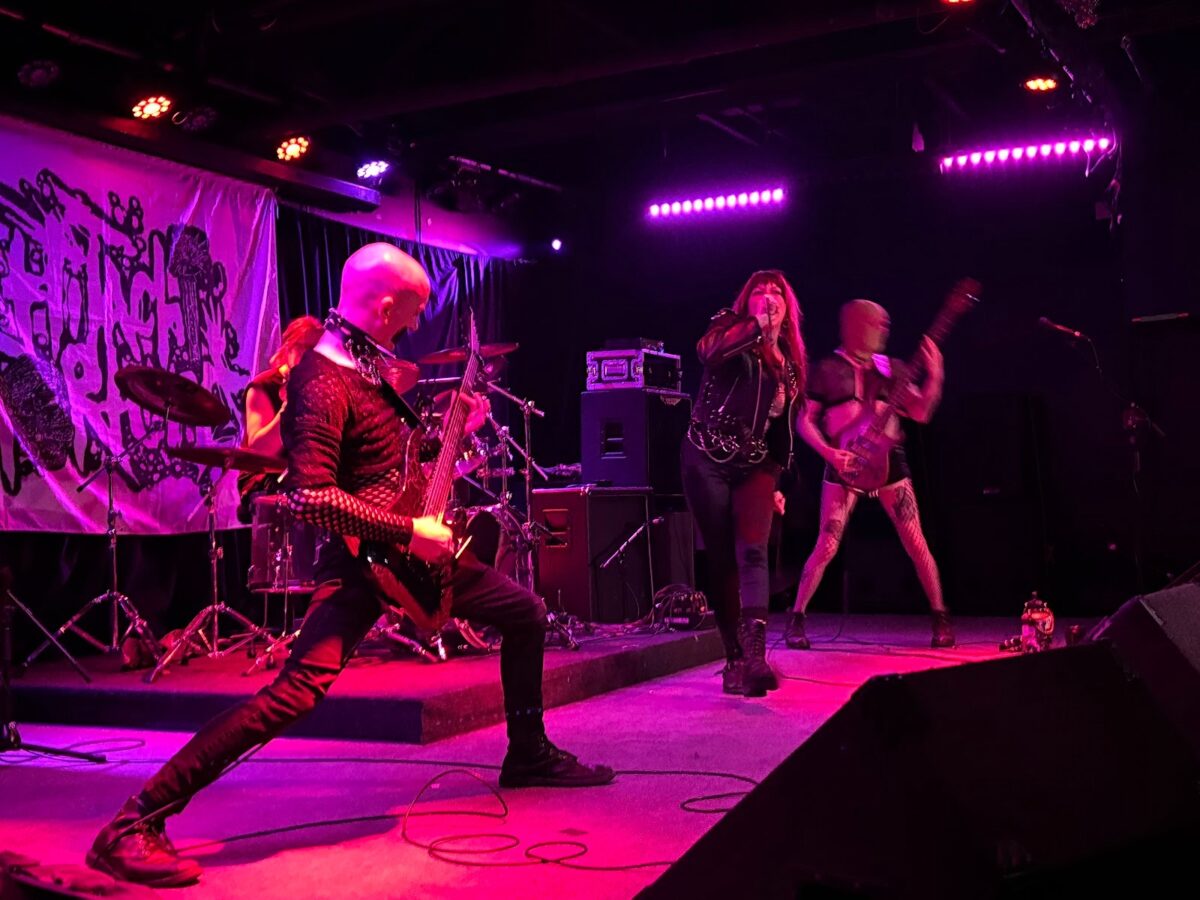
Unique, salacious, and memorable was the first sight of the lead guitarist and bassist. Both of them had masculine frames with shiny bald heads, contrasting their revealing fishnet shirts and pink harnesses, paired with tape and ski-masked covered faces respectively.
Even more eye-catching was the lead singer, feminine and powerful, dressed in a shoulder-padded silver-studded leather jacket in black-heeled boots. Her burnish red hair was dyed blood under the stage lights, paying an atmospheric ode to the band’s gruesome name.
It wasn’t that Hitachi Torture was good at drawing your attention, it was that Hitachi Torture coudn’t help but draw your attention. For all intents and purposes, Hitachi Torture aimed to be a spectacle, and the band accomplished that spectacularly.
Matt, the lead guitarist, had his legs in eccentric athletic rictuses the entire show, all while ripping riffs across the frets with impressive speed. Jeel, the bassist, swayed and spinned like a puppet on an erratic string, as he played bass lines that could not have been from anything but muscle memory.
As for the music itself: Vassia, the drummer, exercised a shocking amount of restraint, finding just the right moments in between vocals and strums to emphasize the beat to its greatest impact. Kat, the vocalist, complemented her band well, sporting a call-and-response-like song structure with the instrumentalists, which allowed every piece of the band their moment in the sun.
Hitachi Torture is meant to be optimized chaos—every piece of their stage persona has been put together to be as offensive and shocking as possible—so much so that you physically can’t look away.
It’s no surprise why Hitachi Torture has become so locally popular. They walked into Chapel of Bones not just ready to play music, but to perform.
Noctomb:
Noctomb was the final act of Anti-Sapien. How could the band possibly follow up Hitachi’s Torture’s performance after their electrifying demonstration?
The short answer is: they couldn’t.
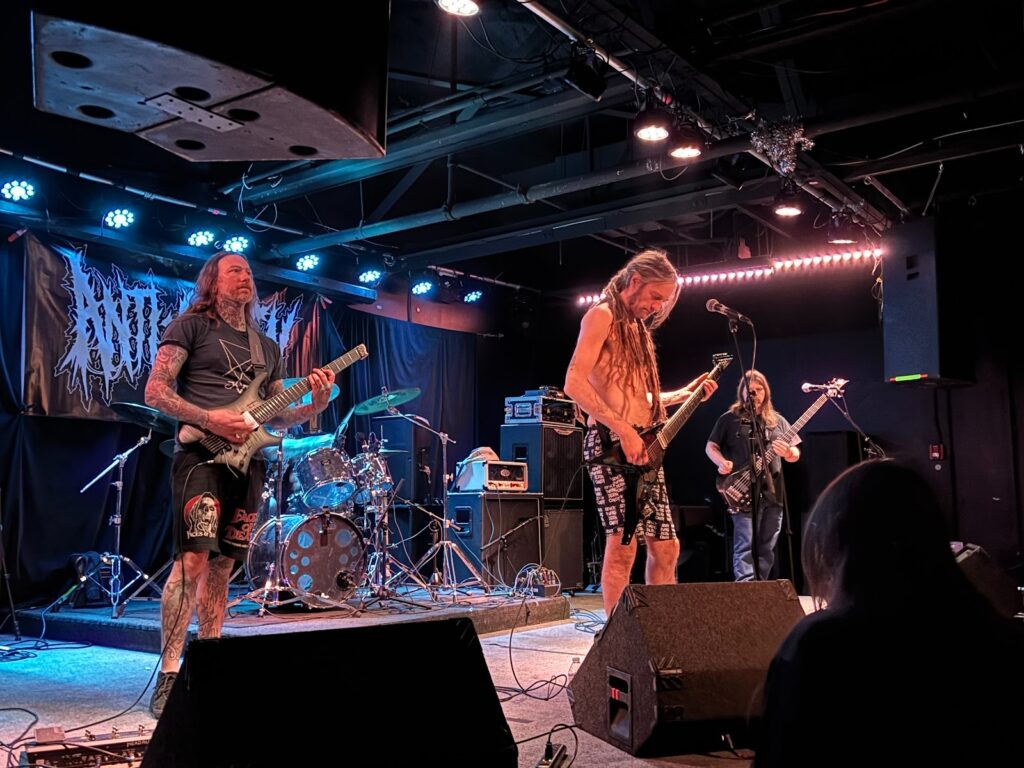
The longer answer is: they couldn’t, and yet, Noctomb’s performance was still my favorite amongst the three bands at Chapel of Bones that night.
The reason why is the same reason why I fell in love with live music in the first place; it brings people together.
There is something as deeply touching as it is charming about a shaggy haired man, shirtless in gym shorts shouting: ‘watch out for the friends you brought tonight, because it’s not fun to party if one of them dies from an overdose,’ and ‘you have more in common with the neighbor you f—ing hate than a billionaire!’
This is indirectly quoted by Nathan Stokes, the vocalist and rhythm guitarist of Noctomb.
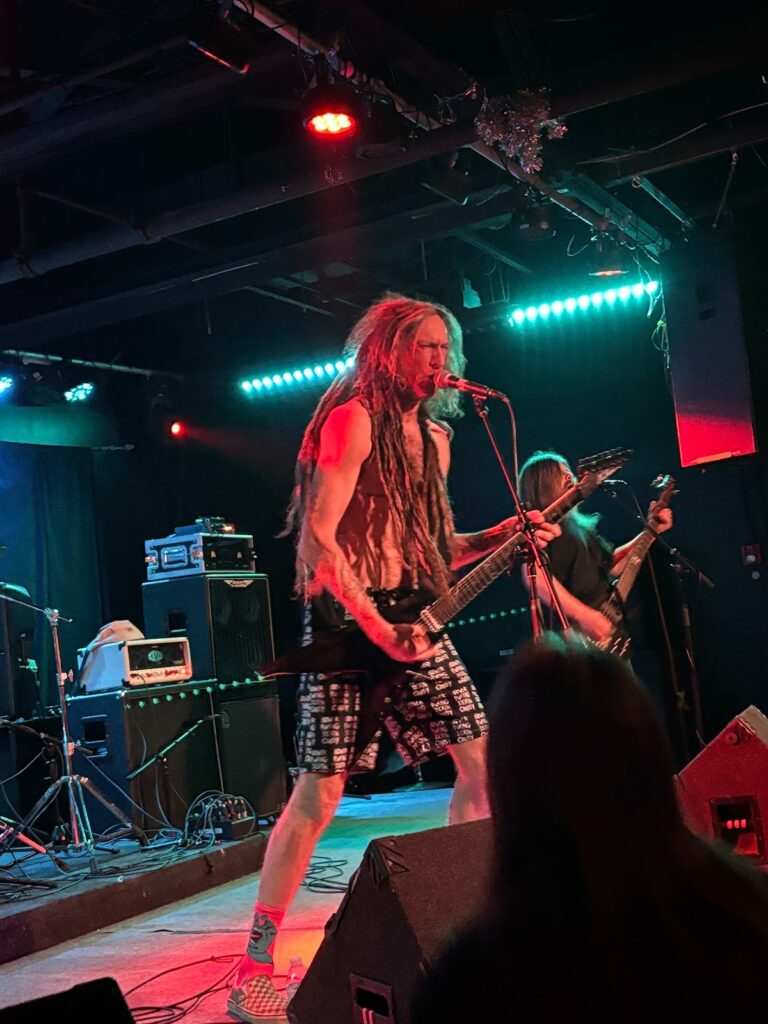
Even now, reading Stokes’s words may seem crass, but the intent behind them was clear to me: take care of your community.
A Brief Interlude: The Metal Community
If there is anything I’ve learned from the live music scene, and especially from the local metal community in Raleigh, it’s that metalheads are some of the most compassionate and thoughtful people you will ever meet.
That assertion comes stapled with a heady cognitive dissonance —how is it possible that a genre of music so harsh and intense is able to share such a welcoming community? In reality, the question answers itself.
It is only because welcoming communities exist that music genres like metal are born.
Let me explain. For the sensible person, it is impossible to look around you and pretend that the world doesn’t absolutely suck right now.
As of 2026, we live in a tumultuous period where war, poverty, disease, and injustice condemn millions of innocent people to suffering and death by the hour. For the rational human being, these realities are non-sensible. They are unfair. They are cruel.
And yet, it is still taboo to broach topics like class divide and addiction in casual settings, let alone in ‘professional’ settings.
The metal genre stems from the frustration of being silenced in the face of injustice. That is why metal culture is so non-conventional; everything from deafening music to eccentric fashion is a rejection of propriety.
Metal is screaming in the face of a world that pretends it isn’t unfair.
For these reasons, metal fosters a tight-knit community that has been built on the foundation of helping others—Noctomb reminded me of that.
Even though some audience members had filtered out after Hitachi Torture’s performance, Noctomb remained earnest, confident, and true to the spirit of what metal is meant to be and who it was meant to be for. Ultimately, that attitude roused the remaining crowd to the loudest cheers I had heard that night.
Back to Noctomb:
But enough about culture. What about Noctomb’s sound?
Noctomb seamlessly blends punk rock and doom metal to create a melodic and refreshing listening experience. With Matt Couchon as the bassist, Patrick Cotter as the drummer, Stokes as the rhythm guitarist, and an unnamed excellent sub-in as the lead guitarist, the four had a satisfying and harmonious synchronization that I ascribe to the strength of doom metal.
The tones of Noctomb’s guitars were so striking, pleasing, and clear to listen to that it may have also made Noctomb my favorite musical performance of the night.
Dunmharu may have had the best audience engagement and Hitachi Torture may have had the best stage presence, but Noctomb, in my opinion, had the most heart—and when it comes to live music, heart is the most important ingredient in the sauce.
To Conclude:
Chapel of Bone’s Anti-Sapien was an enthralling show, with variety and excitement to be found at every stage of the performance. It’s a testament to the venue’s success that even on a freezing Thursday night, the crowd was as lively as it was, pulled in by the thrall of Noctomb, Hitachi Torture, and Dunmharu.
Live music is a place for people to come together and become something more than the sum of their pieces. For just three hours a night, the voices of the crowd become one, our limbs tangled together like knots in the mosh pit. Suddenly we aren’t all that different from each other when the stage lights have painted us all blue.
When you look at it that way, the power of metal comes from more than the beating of drums, or volume of a singer’s voices, or the twang of a guitarist’s strings.
It comes from the people. It comes from you and me.
–Killian Le
