
A friend once told me, “it’s impossible to understand and hate someone.”
I laughed at the time. It was a bold and, to some extent, generous claim considering that the most evil people to ever walk the Earth usually have a sympathetic sob story at the root of their remorseless tendencies. As a result, I wholeheartedly disagreed with her assertion. She rolled her eyes, unwilling to argue with me. We quickly moved on from the topic after, reminiscing about ex-friends over flat soda early into the morning.
Strangely, it wasn’t an encounter with an impatient driver or a despotic professor that struck the memory back into my skull. It was a honey bee.
To preface, I believe I have a healthy indifference towards insects.
I won’t jump and scream at the sight of a cockroach, but I won’t let a butterfly near me either. By that regard, honey bees also exist under my democracy of distance.
Despite that opinion, I have been taking An Introduction to the Honey Bee and Beekeeping (AEC 203) with Professor David Tarpy at NC State as of August 2025. I figured that learning about bees had to be much different than bee-ing near them.
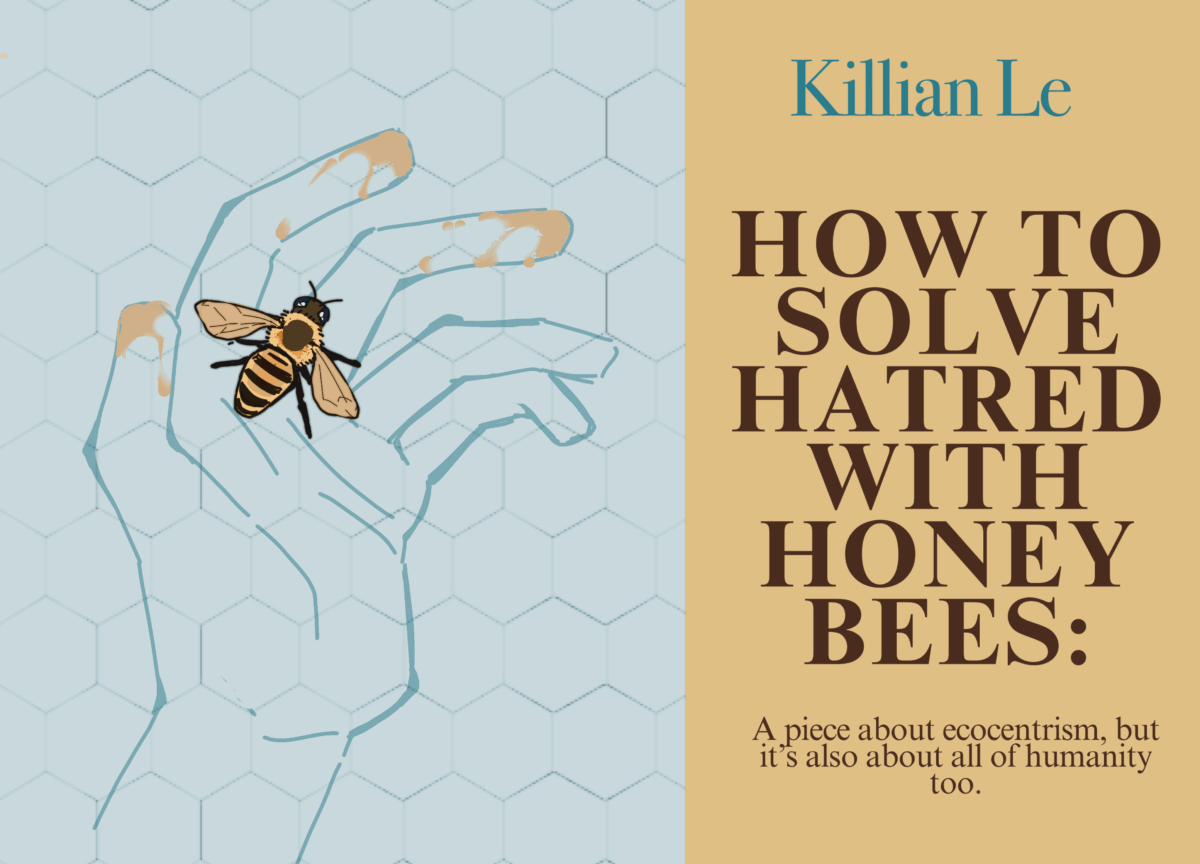
Two months later, picture me standing on a sidewalk, running late for an exam. She landed on my phone as I was waiting for the bus. Yes, contrary to pop culture depictions of honey bees (à la the “Bee Movie”), every honey bee you’ll ever see outside of the hive is female. She was smaller than most I’d ever seen, with beady onyx eyes and a lithe tapered abdomen. I meant to shake her off immediately, but a sudden realization gave me pause.
The “Bee Movie” wasn’t that influential.
Honey bees are an “it” in the human collective unconscious. The average person doesn’t encounter a singular honey bee and think “he” or “she.”
Heedless to my conflict, she crawled on my hand. Instead of recoiling, I felt how soft the fur on a honey bee’s thorax was for the first time. I wondered if she was sniffing the leftover cinnamon roll frosting on my fingers. I recalled my professor calling this behavior towards humans “harmless curiosity.”
Here’s a question: Do honey bees have feelings?
If they do, how many other insects have feelings? Do insects experience emotions the same way humans do? I had no idea. I knew it was more than a possibility, but I had never seriously considered it before. The average person doesn’t try to understand what a bug is feeling either, after all.
And yet, I was taught how to understand her by smarter people in my 11:45 a.m. biweekly class. I understood that she had followed the sun here on a mission coded into the very biology of her species. I understood that she found me sweet instead of dangerous because I smelled more like cinnamon roll than banana bread.
At that point, she was satisfied with the thoroughness of her inspection and took off. It seemed that AEC 203 had transformed my dislike of honey bees into a quiet sense of wonder right under my nose—my sense of smell could never match a honey bee’s, anyways.
I still don’t entirely agree that “it’s impossible to hate and understand someone.” There are very few things in the world that can be stated in certainties. I would, however, agree that it is extremely difficult to understand a honey bee and still hate her.
— Killian Le
